

Can I Put My Garden Over My Leach Field
 Planting a Garden Over or Near Septic System Components
- POST a QUESTION or COMMENT about gardens, fruit trees, vegetables planted over septic system components
InspectAPedia tolerates no conflicts of interest. We have no relationship with advertisers, products, or services discussed at this website.
This article explains the types of gardens or other plants that should or should not be planted over or near septic fields or other septic system components.
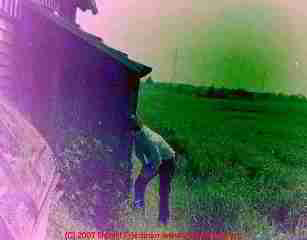
The page top photo shows the author inspecting the juxtaposition of field crops to a septic absorption field in Germany in 1968.
We also provide an ARTICLE INDEX for this topic, or you can try the page top or bottom SEARCH BOX as a quick way to find information you need.
Planting Fruit, Vegetable, or Ornamental Gardens Near or Over Septic Systems
 This is a guide for homeowners who are planting trees, shrubs, gardens, ground cover, or other plants near a septic system and who need to know that can be planted near or over septic system components like the septic tank, distribution box, and drain field or soil absorption system.
Planting the wrong things or in the wrong places can lead to the need for expensive septic system repairs.
Planting trees, shrubs, and even some ground covers over septic system components are causes of septic system failure in the drain field, leach field, seepage bed, or similar components.
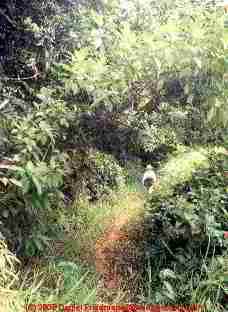
Photo: giant trees & shrubs dwarf walkers in this Costa Rican jungle where very wet soils can make septic system absorption design difficult.
[Clickto enlarge any image]
Planting fruit trees, or vegetables (or anything else edible) over the septic drainfield might produce food that is unsafe to eat:
see SEWAGE CONTAMINANTS in FRUIT / VEGETABLES for details.
Question: Is it Safe to Eat Food Grown Near the Septic System?
I am trying to determine if it is safe to eat the lemons and tangelos [planted or grown] near the septic system of our home.- K.P.
The short answer is it's better to keep fruits and vegetables away from septic systems, especially septic drainfields but above-ground crops such as fruit trees are less likely to be contaminated.
Watch out: gardening or planting anything but basic grass type groundcover over septic drainfields risks damage to the septic system by soil compression, damage to pipes, root invasion of pipes - all problems that can lead to costly septic system repairs.
Details and report of a study documenting bacterial hazards in fruits and vegetables actually watered with septic effluent [a more stringent test case] are
at SEWAGE CONTAMINANTS in FRUIT / VEGETABLES.
Watch out: do not plant a raised-bed garden over the septic drainfield. Constructing a "raised bed" garden which requires the addition of soil above surrounding ground levels can damage the system or can reduce soil transpiration thus preventing the drainfield from functioning properly. Watch out
Watch out: even above ground edible plants such as leafy vegetables or lettuce may become contaminated by sewage splash-up onto the plants during watering or rainfall.
Planting a fruit or vegetable garden over or near septic system components raises some important questions:
- Will there be pathogenic or chemical contamination of the soil (bbacteria, viruses, cleaners) below the garden?
- Will septic system pathogens enter in or contaminate fruits or vegetables planted over or near the septic system?
- Will chemicals or salts passing through the septic system harm nearby plants?
- Will the garden planting itself harm the septic system in some way?
The effectiveness with which the soil biomat is treating pathogens in septic effluent, the ability of the soil to filter effluent, the chemicals or salts entering the septic system, and the type of plants placed over or near the system are some of the factors that lead to answers to these questions. [The photograph above shows our vegetable garden gone wild in Costa Rica.]
- Septic effluent contains chemicals and pathogens which are potentially unhealthy or harmful to people, animals, or plants.
If a septic absorption system's biomat is functioning successfully, the level of these pathogens is reduced by up to 45% for conventional septic systems, up to 70% for advanced treatment systems, and for more advanced (and rarely found) systems it is possible to treat effluent to a level of sanitation similar to that of typical surrounding surface water before effluent leaves the drainfield.
So there is a reasonable chance that food-plants located over or close to a septic drainfield contain harmful levels of bacteria or other contaminants.
See SEWAGE CONTAMINANTS in FRUIT / VEGETABLES. The "safe" distances between edible crops and septic components depend on
- The level of treatment of septic effluent achieved by the onsite septic or wastewater treatment system
- The soil type (see below)
- The crop type (see below)
- Possibly seasonal or other changes in surrounding surface runoff and groundwater, independent of the individual septic system but affecting its performance and thus its level of treatment of the sewage
- Soil types affect how the septic system behaves and how it affects nearby plants of any kind. Clay soils release cleared effluent in perhaps a few inches but then clay doesn't perc well and is bad in general for a septic location. Sandy soils permit much greater travel of effluent and pathogens, certainly several feet.
These "close" distances do not even consider what happens when the drainfield is not working well or is in failure. In that case pathogens may be released to the general environment and might travel any distance from the septic field.
- Root crops such as carrots or potatoes which develop in the soil are likely to pick up pathogens from effluent in the soil over, next to, or downhill from drainfield trenches or galleys.
- Leafy crops such as lettuce or perhaps broccoli which develop above the ground but close to it may be contaminated by pathogens that splash up from the soil surface during watering or during rainfall.
- Above ground crops that grow on a raised vine such as cucumbers, tomatoes, or peppers may fare better if they must be planted over or close to septic system components, since they are higher up and less likely to be contaminated by soil splash-up.
- Salts and the septic system: Homes whose water supply is "hard" and which employ a salt-based water softener system are more likely to be passing high levels of salt into the septic drainfield. Not only does this salt risk harming the drainfield operation (mineral clogging or damage to the biomat) but such salts may also damage some plants that grow nearby.
- Chemicals and the septic system: At this website we've advised strongly against use of "magic bullet" chemical or other septic treatments as some of them are toxic and environmental contaminants. Some of these may also contaminate your garden.
See ROOT KILLERS in SEWER LINES or SEPTIC PIPES.
- Gardening activities such as walking or digging into the first few inches of soil over a drainfield are not likely to damage it.
Watch out: driving equipment such as a plow or roto tiller over a drainfield can compress soil below or damage piping and drainfield trenches
Not "functioning properly" here means that the drainfield stops successfully treating the pathogens that flow into it. It stops working and begins discharging unsanitary effluent into the environment, and into your garden.
Research: gardens planted over or near septic fields
- Day, Susan D., and Ellen Silva, PLANTING ON YOUR SEPTIC DRAINFIELD [PDF] Virginia Cooperative Extension, Pub. 426-617, retrieved 2019/08/27 original source: https://www.pubs.ext.vt.edu/content/dam/pubs_ext_vt_edu/426/426-617/426-617_pdf.pdf
Reader Comments & Q&A
Jennifer
You ask a perfectly reasonable question but not one I can answer with certainty, as I have no information about factors that would make the vegetable garden definitely safe or definitely unsafe.
In general soil bacteria break down sewage;
Adding topsoil and plowing the future garden are good ideas. It might be most effective to do that ASAP, then wait a year. By giving the garden soil more oxygen (by plowing) you help put the aerobic bacteria to work breaking down pathogens.
If there was actual sewage on the area surface, it might be useful to have a representative soil sample tested for level of e-coli bacteria. Do this at the end of your year wait. Don't expect zero bacteria, but do expect little or no e-coli.
As you'll read in this article series, the principal garden sewage pathogen risks that we've found and documented were from raw sewage on or splashing-up onto crops close to the ground.
Do keep me posted, especially with what you find a year from now.
Best to you
Daniel
We had an old septic system, with lateral lines, replaced with a complete new system in a different place. If we let the old lateral line field sit for 1 year can we plant a vegetable garden on top? We would till the soil twice and add a bunch of top soil.
It might be important to know the lateral lines where not functioning properly in the first place, which is why we had the system replaced.
Tamara,
Usually fruits above the height of spash-up of pathogens from the soil during rain pr watering wll be ok
Ronald
Thank you for helpful question. New paragraph.
The problem is not usually that the tree plant or shrub near the septic dies but rather that the nutrients in a septic effluent are so delicious to the tree planter shrub that it grows like crazy and sends roots that invade and damage septic system.
That's why you will see in this article series that plants with deep or aggressive roots are Best Kept away from the septic drain field.
I plan to plant a Southern Magnolia near the septic tank drain field (not exactly sure of the boundaries of the drain field). Two Questions:
1. Is planting this magnolia potentially hazardous to the drain field?
2. Will planting ANY TREE / SHRUB over or near a drain field cause the tree/shrub to die or not do well ?
I moved into a house that has a large mature approx 15ft -20ft lychee tree right on the edge of the drAin field. The drain field was replaced and is new as of 4 nonths ago. My question is when the lychee tree fruits are they safe to eat?
The roots didn't seem to bother the old system. It was simply old and was time to replace
Tamara
Thanks for the septic and garden bed question, LeeAnn.
There are two different things to avoid:
1. over the septic tank itself, what you propose won't hurt the tank, but what the heck: when you need to pump the septic tank - as must be done periodically to avoid ruining the septic drainfield - you will have to cut through or dig up or remove the rock garden to give access to the tank in one or more places.
So it's a bad location to start and it risks sewage contamination from spills during pumping.
You could build an access well or install septic tank risers that poke through your garden and come to the surface above it to give septic maintenance access but take care not to spill sewage into your veggies during pumping.
2. Over the drainfield: You never want to put down plastic over the septic soakaway drainfield itself.
That interferes with transpiration - basically disposal of some of the sewage effluent by evaporation, and it starves soil bacteria of oxygen, thus preventing sanitary processing of the sewage effluent and thus contaminating the environment around your home.
We just moved into a new house and there is a rock garden bed near the septic tank. I'm not sure exactly how deep the septic tank is.
My question is, if I line the bottom and edges of the garden with the plastic tarp material that you use for a greenhouse, and put new dirt in it, would it still be safe to grow vegetables there? The garden is not moveable and it is not on top of the septic tank, just near it. Thank you.
cj said:
"When planting grass over a septic system drain field, don't add additional soil, unless it is a small amount of soil to restore an eroded area or to replace soil pulled up by the removal of a plant.
After you spread grass seeds evenly over the area, add a 2- to 3-inch-thick layer of topsoil to cover the seeds. Adding a thicker layer of topsoil could prevent the exchange of air and water that are necessary for the drain field."
Found out my veg.gard.is atop of septic is are helth in danger?
I have build 3 raised beds within a 10' distance, uphill, from the distal end of a lateral line. When choosing the location, we were misinformed about the location of the septic system. We later saw evidence for the drain fields and become concerned about the close proximity.
I have moved the raised beds 20' distance away from drain field. A
ll the soil in the original raised beds was brought in, and the bottom of the beds lined with landscaping fabric. I don't think the roots ever penitrated through the barrier, but I am still very concerned that we may have put ourselves at risk for food contamination.
The location of the drain field is on top of a sunny hill, in a silty clay and we do not have a shallow water table. Now I'm wondering if 20 feet far enough away? Is there a guideline to follow on how far is deemed safe?
Tim I'm doubtful that any vegetable roots extend down to the depth you describe for your drainfield, but, then, my OPINION is that a drainfield that's 12 feet below the soil top also will not work to treat effluent successfully, as there will be too little oxygen.
I plan to build a septic system with a drain field which will be approximately 12 feet below ground level. Is this distance great enough to allow for root vegetables, such as potatoes and other non tree type vegetables to be grown safely? We have limited gardening space.
tjd15sep@yahoo.com
Thank you
If You'll be spraying sewage effluent onto your vegetables above ground - that's not something I'd recommend.
I have an aerobic system and was wondering if a vegetable garden could be planted near the sprinklers to aid in watering it
Kay I'm a little scared to give a definite answer since defining "close" , well, as my guru Mark Cramer (Tampa FL) says " .. it depends"
Depends on:
Soil slope: crops downslope from a drainfield are more at risk of sewage comtamination from surface runoff and ground-water
Soil properties: how quickly and easily does water move from one location to another under ground - flow rates, porosity, soil composition
Type of food being grown: above-ground crops are less at risk for bacterial contamination through ground water but might be contaminated by rain splash-up if surface runoff is contaminated
So if you are confident that your crops aren't being drained-into by sewage effluent nor being contaminanted by sewage spash-up during rain, you're in at least a defensible position. Whether that's ten feet or 50 feet I can't know for your particular site. If never the less you twist my arm and demand a number I'll make one up: keep the food crops at least as far from the septic fields as you'll keep your drinking water well.
Search InspectApedia.com for SEPTIC CLEARANCE DISTANCES to see a full table of those numbers.
I would NOT install raised bed gardens over a septic field in any event as adding soil cover beyond the original design depth will reduce transpiration and risks damaging the drainfield or shortening its life.
I read your article on growing vegetables on a property with a septic tank and drain field. Can you define "close" to a septic drain field as you refer to it?
That is, roughly how many feet away from the drain field, pipes, etc.should in-ground gardening be to be assured that even root vegetables would not absorb waste, assuming the system is functioning correctly? If raised beds are installed, how many feet away from the drain filed to assure no absorption of contaminants?
How far to avoid reducing the effectiveness of the field by covering ground it with the raised beds? Thank you so much for your help.
Is it safe to grow vegetables over old septic tank area that has not been operational for 30 years?
Anon no honest professional could declare your home safe based on a one-line e-text. If you are asking if the septic tank is a risk to a garden growing edible foods, if the septic tank is leaking or sewage is released near the garden that could be a potential health concern - more or less depending also on what is being grown for consumption.
i am buying a new house with a septic tank next to the garden over the fence is it safe
i am buying a new house with a septic tank next to the garden over the fence is it safe/PLASE
You mean opposite side of the tank from the side of the tank connected to the leach field. Probably ok provided there's no sewage leak or backup near the garden beds.
Im looking to have raised garden beds 10 feet from my septic tank on the opposite side of the leech field. Tje tank
I've planted my Maori potatoes which are showing their
First leaves and found that the hoses for the sewage run off from my house is under them. Are they all ready contaminated? Do I need to transplant them now or am I too late?
Deeja
This is a good question for your local nursery - it appears to be a water and spray impact tolerance question not a sanitation question. You might start with a mold-resistant plant.
I have roses on trellis in backyard that gets sprayed with aerobic treatment system. Are there other plants for the trellis that will thrive better with the spay? The trellis is a perfect focal point in the yard. The yard gets sprayed once or twice a day. The trellis gets hit pretty hard from one sprayer head.
That's a great question, Lisa and I don't know a firm answer because there are so many variables including:
- the degree of sewage effluent water that actually was in the soil that will be in contact with plant roots
- the soil properties
- the soil moisture level
- the health of aerobic and anaerobic bacteria in the soil
- the type of crops intended for planting and their root depth
We looked at this question some time ago in assessing how long it would take for raw sewage in a latrine pit or outhouse pit to break down if the pit were abandoned and covered - that represents the most extreme or difficult case - far more difficult than the situation you describe. In that case the answer could be a decade or more.
In the case of a septic system that was not sending effluent to the surface, my in-expert OPINION is I'd wait a year or more before planting root crops (potatoes) or low crops that might be contaminated by rain splash-up. Taller crops that produce edibles high enough above ground to avoid those risks, and fruit trees, are safe for planting sooner.
We are terminating our septic for city sewer. How long before we can you ground for planting a vegetable garden? Safety wise for uncontaminated food.
...
Continue reading at GRAZING ANIMALS OVER SEPTIC SYSTEMS or select a topic from the closely-related articles below, or see the complete ARTICLE INDEX.
Or see these
Articles on Plants & Grasses On or Near Septic Systems
- PLANTS & TREES OVER SEPTIC SYSTEMS
- GARDENS NEAR SEPTICS
- GRAZING ANIMALS OVER SEPTIC SYSTEMS
- GROUND COVER, IVY OVER SEPTIC FIELDS
- ROOT KILLERS in SEWER LINES or SEPTIC PIPES
- SEPTIC TANK GRASS or SNOWMELT
- SEPTIC TROUBLE SIGNS, OTHER
- SOAKBED SOIL CONDITIONS
- SEWAGE CONTAMINANTS in FRUIT / VEGETABLES
- TREES or SHRUBS OVER THE SEPTIC FIELD or TANK
- SEPTIC TANK CARE INSTRUCTIONS
- SEPTIC DRAINFIELD FAILURE CAUSES
Suggested citation for this web page
GARDENS NEAR SEPTICS at InspectApedia.com - online encyclopedia of building & environmental inspection, testing, diagnosis, repair, & problem prevention advice.
Or see this
INDEX to RELATED ARTICLES: ARTICLE INDEX to SEPTIC SYSTEMS
Or use the SEARCH BOX found below to Ask a Question or Search InspectApedia
...
Ask a Question or Search InspectApedia
Try the search box just below, or if you prefer, post a question or comment in the Comments box below and we will respond promptly.
Search the InspectApedia website
Note: appearance of your Comment below may be delayed: if your comment contains an image, web link, or text that looks to the software as if it might be a web link, your posting will appear after it has been approved by a moderator. Apologies for the delay.
Technical Reviewers & References
Click to Show or Hide Citations & References
Publisher InspectApedia.com - Daniel Friedman
Can I Put My Garden Over My Leach Field
Source: https://inspectapedia.com/septic/Plant_Garden_Over_Septic_Fields.php
Posted by: masonworeirsis.blogspot.com
0 Response to "Can I Put My Garden Over My Leach Field"
Post a Comment